
This is basically my notes on clawing my way out of depression. It's a lot. It's intense.
Nothing here should be interpreted as a suggestion to avoid any solution. I tried many things. Some weren't helpful, some were. I think it's sensible to try all of the commonly recommended solutions: Therapy, medication, exercise, diet, etc..
People who believe they are wise sometimes tend to annoyingly speak in riddles. I believe this is because we are terrible at accepting things we are told, and much better at accepting things we have figured out for ourselves. Therefore, the question can be far more useful than the answer.
I am tired of this, you will find no riddles here. This is where I give you what I believe are the answers. This is likely to backfire, and decrease your chances of understanding these things which I believe are most important to you. You have been warned.
This page will never be complete or faultless. Please send me feedback to help make it more useful to more people.
People get put off because I state things here as if I know them. I don't know anything. I cannot proove that I exist. It's just tedious to repeat that in every statement I make.
"'How is it that you always assume you're right?' 'I don't, I just find it hard to operate on the opposite assumption.'" - House
There are a few reasons to believe something. I think they're all important to consider, and try to balance:
We live in a world where we are constantly bombarded by people telling us that what will make us happy is more money, and more possessions. To get us to give them money - because they believe it will make them more happy.
But money and possessions aren't what makes us happy.
"Advertising has us chasing cars and clothes, working jobs we hate so we can buy shit we don't need." - Tyler Durden, Fight Club
What makes us happy is meaning, purpose.
"There's no escaping reason, no denying purpose, for as we both know, without purpose we would not exist. It is purpose that created us, purpose that connects us, purpose that pulls us, that guides us, that drives us; it is purpose that defines us, purpose that binds us." - Agent Smith, The Matrix Reloaded
Many people will say that you need to find your own meaning, make your own purpose. But I think those who succeed at being happy always come down to the same general category:
The meaning of life is making other people's lives better. (AKA compassion, generosity (not monetary), kindness.)
Because that's how we're wired. Because that's how we evolved, as social animals. Making other people's lives better releases the happy chemicals in our brains. More reliably and sustainably than anything else.
Don't do it because you should, or out of some misplaced sense of obligation. Don't do it out of hope for reciprocation. Don't do it because you might be shown appreciation. Do it because it feels good, directly, because that's how you're wired, because that's how humans are supposed to work.
I think I managed to miss this for so long because early on I developed the belief that logic was all that mattered, and failed to grasp the importance of emotion. We are emotional animals. Happiness is not logical. Logic alone will not lead us to happiness. Logic alone will lead you to existential crisis and absurdism. (This problem may have been aggravated by Rational Choice Philosophy.)
Focusing on our own problems makes us miserable. But when we focus on other people's problems, that makes us happy.
The side effects of this belief are also pretty nice (helping people).
I used to feel like running was out of place here. But it has proved itself to me so thoroughly, so repeatedly, that I had to move it to the top.
For me, running is the cure for depression. I need it to survive. This is common.
I find trail running more useful than road running. Swoopy trails are good. I believe varying route helps. Running with other people sounds like a good idea.
An article on running vs. depression and anxiety.
So many youtube videos on the effectiveness of running to fight depression.
Humans are made for running. Nothing can run as far as we can.
After digesting being kind to people for a while, I was still having some difficulty. alex4nder, in a completely unrelated IRC channel, said "Darxus: the solution to existential despair is losing attachment". My immediate reaction was thinking I wasn't attached to anything, but I tried to think of what I could possibly be too attached to, and it occurred to me that I do have a tendency to hold on to anger (although probably not the kind of attachment he was talking about). And really, that's not useful.
For all things in life:
For some time I have appreciated and attempted to apply this Zen practice (Stranger in a Strange Land is what got it to sink in). I didn't even notice I was really failing to let go of being angry at people. Any person I saw doing something wrong, I remained just a little angry at them for it. What else do I still need to notice and learn to let go of?
"Holding on to anger is like grasping a hot coal with the intent of throwing it at someone else; you are the one who gets burned."- Buddha.
From this I progressed to dealing far better with unpleasant emotions in general. When I found myself thinking of something unpleasant, I used to cringe, and try to block out the emotion. I got pretty good at it. I thought I was clever. But it turns out that fighting off those emotions is a lot more unpleasant than just experiencing them. Now when I notice myself cringe, I go back and think about whatever it was, feel the associated emotion deeply, appreciate it, and let it go. This has dramatically reduced my fear of life. Instead of being afraid of things that will happen that I'll need to avoid remembering, I cherish new experiences as they come. This causes a rather more appealing outlook.
"The foundation of all mental illness is the unwillingness to experience legitimate suffering." -Carl Jung
It's okay to feel bad, to suffer. In fact, it's good and necessary. Experience it. Appreciate it. Then let it go.
The article I'm Christian, unless you're gay said some interesting stuff about loving everybody. And it occurred to me that loving people I don't know could be a much more pleasant way to live than being angry at them. So that's what I try to do. Of course I still get angry at people. But I accept it, and think "...but I love you anyway". That still sounds awful silly to me, but that's fine while it's making my life more pleasant.
It may be useful to try to think of experiences less in terms of "good" vs. "bad" or "pleasant" vs. "unpleasant", and more in terms of perfect in being what it is.
One of the experiences I have found most interesting to try to cherish is the anxiety over going to new social events. Appreciating it as feeling alive.
Now that you're accepting and cherishing all your experiences doesn't mean you should let people continue doing horrible things. Accept it, so that you can get on with your life, then do what you can to change it.
Fear is a great, useful emotion. But the short e-book Flinch (which I don't actually recommend) made the interesting point that we evolved to react to just about every unexpected thing as if it might be a hint of a large predator about to eat us. Because for most of our evolution, that was a very useful reaction. It's not anymore. So use your forebrain a little more, and figure out when you're actually in danger. The rest of the time, don't fear. I wonder if this might be behind the tendency of people to feel like the world is about to end.
It has been said in many ways that richness is not a matter of what you have, but how happy you are with whatever it is that you have. Beyond having your basic needs met, getting more won't make you happier. You'll always want more, until you recognize it will never actually make you happier.
Go rock climbing, mountain biking, boating, skydiving, horseback riding, backpacking.... Do something interesting, and enjoy it, and while you do it, realize that it is a story that will be worth telling somebody. Because for some reason our social system seems to be based on this stuff (reddit). Do it because it's fun, or possibly because it's a valuable experience, but don't do it to impress people.
Spend less time on useless distractions: TV, internet, console games, playing with your phone. Distraction addiction, blinding you from things actually worthwhile in life. Yes, this page falls under "internet", but I'm sure you'd be better off if you never read this page and never did any of those things again, than continuing to use those distractions. Moderation is probably best.
A Cracked.com article that goes into this, with a harsh tone.
I think the basic idea in the book Loving What Is, is that it's not the things that happen to us that can make us unhappy or miserable, but the things we think about what happens to us. And we can change what we think about those things. So if you're miserable, it's because you're thinking things you have a choice not to think. Similarly, a friend told me of a time his girlfriend pointed out to him that "You can be sitting in traffic pissed off, or you can just be sitting in traffic."
For a long time I have believed the universe is a big vacuum fluctuation, although I only found those words relatively recently. If you look closely enough at a vacuum, you will find matter and anti-matter winking in and out of existence. I believe the void split into lots of matter and anti-matter, creating our universe, all one big reaction that will eventually return to nothing. A single, perfect path, from beginning to end.
So that gave me a pretty comfortable base for believing everything is perfect in being exactly what it must be, but it didn't help me believe things would work out okay for me. That part was more tricky.
I used to be very pessimistic. Bad things had happened to me, so I expected bad things would happen again. Things that made me miserable, or freaked me out. I focused on my inability to deal with those problems on the short term. Then I realized, on the longer term, I totally dealt with them. I won. I'm still here. Anything that happens in the future I will probably also manage to find a way through. As with many of the sections on this page, this has been a huge improvement in my life.
At the same time, this is not a reason to slack off on actively making the world a better place.
Right now things are perfect as they are. In the future, they may be perfect because you made them better.
I think a lot of people hear opinions they very strongly disagree with, and assume they could not possibly understand how a person could have that opinion. I think that's a shame. I think it's important to figure out how to understand how that person came to have that opinion. Of course, I'm not saying you need to learn to agree with them - it wouldn't actually be possible to agree with everyone's conflicting opinions. But you can at least understand them. If I disagree with somebody, and I can't figure out why they believe what they believe, I feel I'm the one doing something wrong.
For everything you think about, try to focus on the positive. Something about it that can make you happy.
Do not decide what an experience should be like before it happens. Let it happen and be whatever it is, and try to enjoy it. Instead of being disappointed that it didn't meet your preconception.

I believe that the biggest problem with humans is belief. Our incredible ability to believe what is convenient over what is uncomfortable. What is familiar over what is new. I believe every one of us deeply believes something that is wrong. Especially myself.
No one believes what they do is unjustifiable. Belief is the pin that holds all the wrongs of the world in place. How do we remove that pin?
It took me lots of years of struggling to get out of existential despair, by actively trying to figure out what beliefs could make me happy, to be able to write the things I have written here. I cannot imagine how to convince you. But I think it is the most important work that anyone or everyone could do.
"If you would be a real seeker after truth, it is necessary that at least once in your life you doubt, as far as possible, all things." - Rene Descartes (1596 – 1650)
There's something in Ishmael about it being dangerous to believe that we can decide what is right and wrong. Related to the tree of knowledge.
Yes, I know, you're doomed, we all are. Life is, literally, 100% fatal. But that's not a good enough reason to spend so much time dwelling on everything that could possibly go wrong. Yes, spend a little of that time considering potential problems, but you would probably be better off spending most of that time figuring out how everything could go awesomely. Because that produces happy brain chemicals.
People who are certain do the most terrible things. And your only means of cognition is the same fundamentally irrational goo that they had to work with.
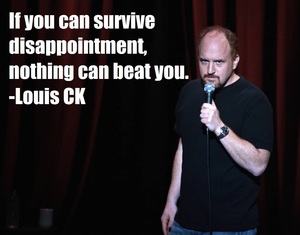
For a long time I reacted to many types of disappointment with severe heart break, and responded by refusing to function, like that was some kind of useful way to retaliate against the universe. At some point it somehow became clear to me that I'm better off continuing to do the things that make my life better.
An important step in this process for me may have been realizing how much I panicked when I didn't find my keys in the first pocket I checked. I generally basically felt like I would somehow die as a direct result. And how un-useful it was to be so emotionally hard on myself. I started telling myself "Don't panic, you will almost certainly survive this day."
Getting more comfortable with these things has made it a lot easier to try. Everything. Which is great.
"Fear is the non-acceptance of what is." - Jiddu Krishnamurti
Many things in life have an incredibly wide range of possible interpretation. It can be tempting to go with the most negative one, to avoid disappointment, but this will make you miserable.
Does your very close friend think you are a terrible person, and you need to stop inflicting yourself on all the nice people at your party? Or do they believe that you are having a really rough time due to being severely over-tired, and would genuinely benefit a lot from a nap?
I spent so much time thinking about things that could go wrong, so I could try to prepare for them, that all I ever thought about was what might go wrong, which made me afraid. An article about how best to enjoy vacations pointed out that thinking about how great it's going to be is way more pleasant.
This took me a long time to figure out, but it's really just a subset of "spending less time thinking about things that make you unhappy, and more time thinking about things that will make you happy, will make you happier, and that's a thing you can consciously choose to do".
Existential crisis is a problem of scale. On the scale of the universe, nothing we do can ever matter. So don't pay attention to it. On the scale of a single interaction between to people, things matter, so pay attention to it.
Summarized from Rick and Morty: The Search for Meaning.
I recently suddenly came out of some pretty deep depression, and the cause may be that I stopped eating so much utter garbage, and started eating a lot of healthy food. I know, it sounds terrible. But, for me, thinking of healthy food as an effective anti-depressant... seems real worth it.
Since controlling your diet is harder while depressed, I think it is likely to be easier to start off by eating as much healthy food as you want. Then start restricting calories. And I have to mention I find OMAD (one meal a day) useful for feeling completely satisfied / full once a day, making it all so much more managable.
I can't believe it took me so long to add this one.
Alan Watts says unpredictability is necessary for happiness (youtube video). That seemed... consistent enough with my experiences. I tended to avoid stuff where I didn't know what would happen, because they were scary. Since watching this video, I've tried to do more things where I didn't know what would happen. And they've been great. I'm not entirely sure if that's because the unpredictability makes me happy, or doing these things that I was avoiding makes me happy, but either way, the belief seems very helpful.
Whatever joy there is in this world- Shantideva, 8th-century Indian Buddhist monk
All comes from desiring others to be happy,
And whatever suffering there is in this world,
All comes from desiring myself to be happy.
"The eye sees only what the mind is prepared to comprehend." - Henri L. Bergson
"If you would be a real seeker after truth, it is necessary that at least once in your life you doubt, as far as possible, all things." - Rene Descartes
I added these two quotes after wondering how I had managed to miss the fact that Buddhism is so focused on being good to other people. Of course I missed it - it's not what I was looking for at the time. So maybe the best recommendation I can give is to consider the possibility that your entire perception of reality is fundamentally flawed. That what you think you want is perhaps not what you actually want.
"I'd rather be happy than right any day." - Slartiblartfast, The Hitchhiker's Guide to the Galaxy
"Cherish the suck."
"Don't fight the flow."
"It will pass."
Halcyon's Tips & Tricks #6 - "GIFTING" - this video was significant in helping me get it.
"What I Learned While Making a Movie About Happiness" - lots of great stuff, particularly scientific evidence that meditation on compassion makes people happier, which is simple and difficult.
How to be happy, according to the Mayo Clinic
How to be happy, according to webmd.com
Buddhist monk is the world's happiest man
Giving Makes Toddlers Happier than Getting
Evolutionary basis of morals, according to reddit
How to be Positive
This is water
The power of vulnerability - TED
The Moral Bucket List
The Egg, a short story
Choose to Be Grateful. It Will Make You Happier.
How to recover from being homeless and unemployed. Aspects of how to live a bit different from the main goal of this page.
"Don't ask yourself what the world needs. Ask yourself what makes you come alive, and then go do that. Because what the world needs is people who have come alive." - Walt Whitman
My two favorite web pages on the subject of religion: